
It seems that the only kind of article more common than “X reasons to go analog” is “Y reasons going analog is dumb.” I tend to be mostly on Team A, though I do love some…ok, never mind, we’re not going to shorten them to “A” and “D”.
But when my coaching group got faced with that title prompt, my brain tried to fill it in with the obvious choices.
“It’s not about analog or digital, it’s about…”
- energy
- Interruptions
- flow
- desire
- feeling
- time
…and that last one seemed to be the most obvious. Why wouldn’t it be about time? After all, time is, as we all know and are told incessantly, time is our most valuable resource. Everybody knows that.
Which is probably why my oppositionally-disordered brain immediately thought yeah, but is it, really?
Time is not a resource, and never has been.
“Time” is really just a label we slapped on a law of thermodynamics (the one where everything slouches towards entropy) along with a bunch of arbitrary Babylonian metrics to give us the illusion of control (as well as the reality of profit).
Along with nano- and milli- and then the sudden jump to base twelve sixty seconds, minutes, twenty four hours, seven days, variably sized months and years (seriously, have you ever really thought about how mixed up our measures of time are?) we also have a zillion ways to talk about the things it does:
Time flies, time heals, time waits for no one. We can have the time of our life, or be out of time, but that’s different than being on a time-out, which is also different than something being timeless. We can be just in time, small time, big time, killing time, wasting time, but that’s ok because we can also make time, save time, which is good if we have to spend time, especially if it’s time after time.
Personally, as someone with ADHD, I have time blindness, which is why I often request that “Time, time, time, see what’s become of me?”*
The reality of the phenomenon we call “time” is that it is not scarce. Nor is it plentiful. Nor is it directly controllable (outside of huge gravity wells, at least, but that’s outside of the scope of this article). it simply is, in the same way that the universe has plenty of space, even if my desk is cluttered. All of these cliches don’t describe time itself — they describe the qualities of time.
Or, more precisely, they describe the quality of our experience of time.
And that is something that we can control (or at least influence).
How to have a good time.
A recent presentation I saw referenced the “Alpine Climb” types of fun:
- Type 1 Fun is enjoyable as you’re doing it.
- Type 2 Fun is not enjoyable as you’re doing it, but you enjoy having doneit, afterwards.
- Type 3 Fun is neither enjoyable during nor after, or as I like to think of it, the “WTF was I thinking?” type of fun.
The thing is, the type of fun you are having at any given moment can be influenced by where you put your attention. If I’m late for an appointment and driving through traffic, my attention could be focused on the future: the people who are waiting, how mad they are getting, what this does to my reputation, etc.
Or I could be on the same drive, in the same traffic, and be paying attention to the fascinating audiobook I’m playing. Or I could get all mindfullish and pay attention to the colors and designs of the cars around me, the expressions on the faces of the people, the architecture of the buildings and bloom of the landscape around me.
Same situation. Same amount of time. But the quality of the experience is entirely dictated by the type of attention I choose to give it.
“It’s not that easy!” No! Of course not! But it’s even harder if we don’t even know that’s how it works.
We don’t need to be better at managing our time. We need to be better at managing our attention. Especially as the world around us becomes more and more filled with systems and devices designed to distract and extract our attention for the profit of others.
“Cui Bono”?**
I think the biggest mistake I made as I began trying to manage my attention — both pre-ADHD-diagnosis and after — was putting value judgements on the types of attention. Obviously zen-like mindfulness was at the top of the hierarchy, and doomscrolling through video clips of burlesque dancers was the nadir. I originally bought into the broductivity hustle-culture myth of optimizing time by “focusing attention.”
What it took me too long to learn is that the kind of attention they were talking about was specifically the kind of attention that would make profit for others. Certainly for the influencers whose courses and apps and books I bought, and also for the platforms that sold them. By forcing my attention into little tiny pieces focused on what have I done? What am I doing? What do I have to do next? they could eventually even profit off of rest and recuperation, with recovery drinks and meditation apps and sleep monitors.
Who is benefiting from my attention with all that busy-ness? Maybe I am, to some extent, but there’s definitely a carving-out of my energy going towards these other people.
And maybe I’m fine with that. Transactional behavior is a part of human society; if I have to pay the App Store to get access to the Bollywood Dance workout app, maybe that’s something I’m ok with (spoiler: I am, 100%).Hopefully, I’m at least aware of the trade, though.
There are other forms of attention that cannot be fractionated.
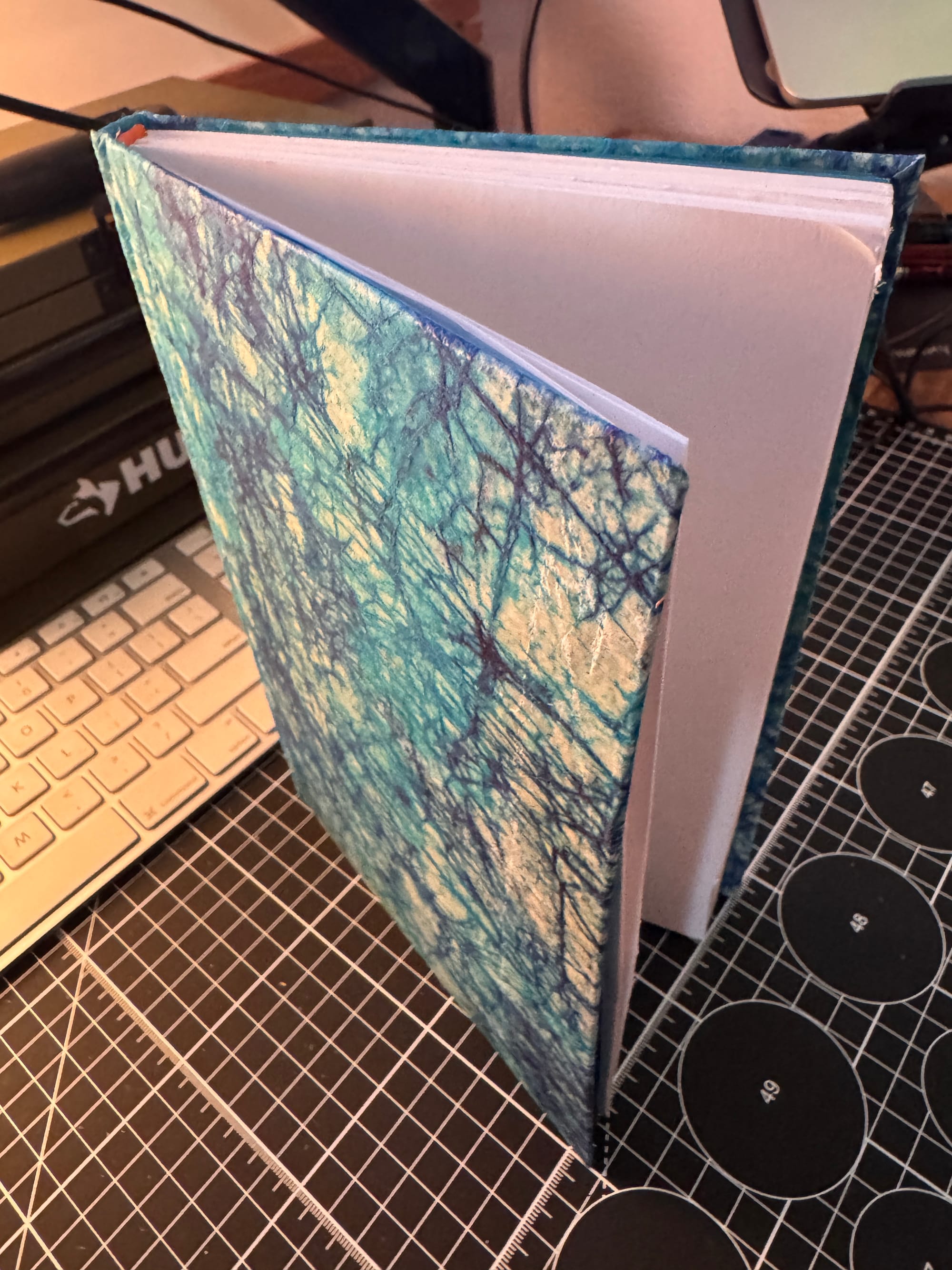
There’s the attention given to my granddaughters hand in mine as we walk home from her aikido class. There’s the shared attention when my partner and I watch a movie together, or the intense mono-focus of working on a bookbinding project on a Saturday afternoon with no interruptions.
In fact, personally, I think the highest quality times I experience are those times when I’m unaware of time — and that’s part of why I prefer to use paper and notebooks to digital devices. My notebook will never interrupt me with an alarm or an alert about what time it is — because it doesn’t know.
Of course, some people have the luxury of turning off notifications, of sleeping in spite of screens, of resisting the deliberate investment of billions of dollars to make the digital devices as addictive and attention-fracking as possible.
Or, at least, they think they do — and more power to them! They should 100% use whatever devices work for them to journal, to plan, to enjoy, to experience time in the way they want to, with a clear and consensual understanding of who is benefiting.
In the end, it’s not about analog or digital. It’s about attention.
* honorable mention to “parsley, sage, rosemary, and time” which were scribbled in my notes but I couldn’t figure out how to make them fit.
** honorable mention to all the dads out there who automatically thought “the lead singer of U2, duh!” I see you, my people.