Polyamorous With My Notebooks
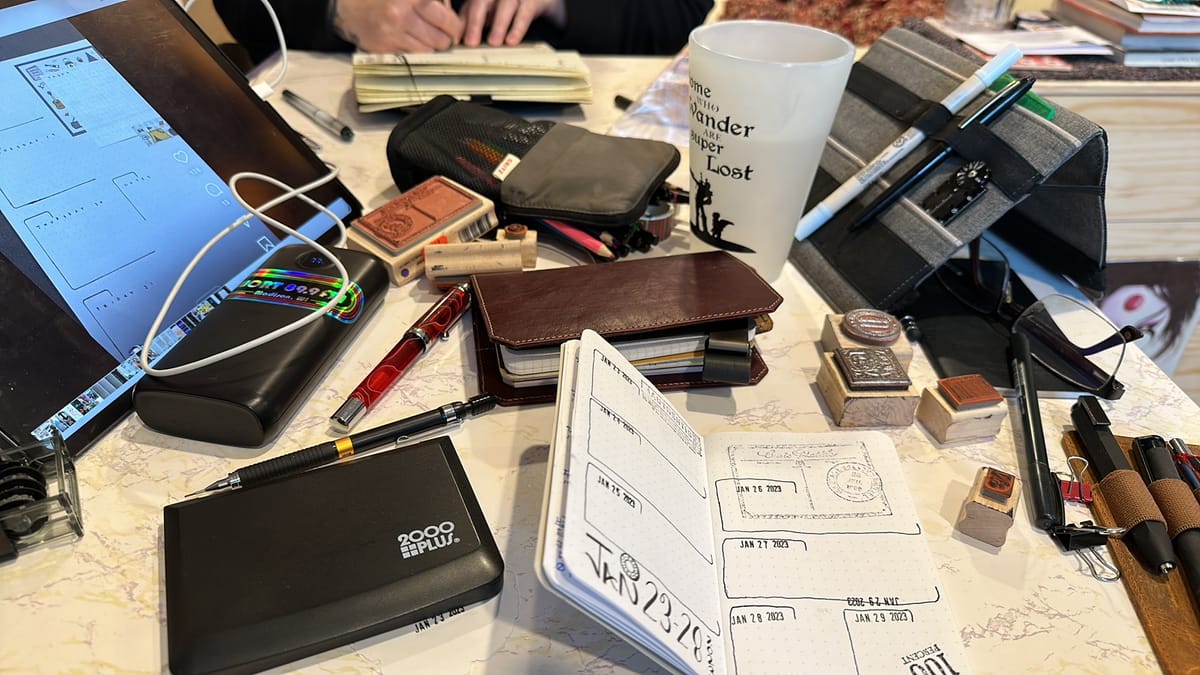
Why I refuse to commit to just one — and how I finally made it work.
Hi. My name is Gray. I’m a compulsive notebooker.
My problem isn’t money. I don’t purchase notebooks indiscriminately, especially since I’ve taken up the side-hobby of bookbinding. It means that my partners and family and friends suffer through an onslaught of bound gifts as I learn the craft,but it also means that when I see a neat notebook my usual reaction is a (certainly overconfident) oh, i could do that.
I can buy. I can make. That is not the problem.
The problem is that I also like to use them.
I like to use all of them for everything.
Is your notebook like your car or your closet?
Most people only use one car most of the time. There’s rarely a reason I get up and have to spend willpower trying to decide which car I’m in the mood to take to work (trick question, we only have one car, and I usually work from home).
On the other hand, my closet is filled with a variety of clothes — and what I wear on a particular day depends on things like weather, meetings, activities, what my partner thinks I look good in, and most of all: what I’m in the mood to wear that day.
Do I want to go classic Connery? Or late Jeff Bridges? Do I want to promote the Electronic Frontier Foundation or look like a maker with my cargo pants and gear-festooned shirt? Do I want to wear that button down that I know Johanna really likes? Do I need to wear nicer shoes because the sponsors will be at the networking event?
I talked to my creative friend Devin about this recently, and his notebook is like his car. He chose a certain Moleskine once and it worked and he’s stuck with it as his default choice. The only variation is when he might have forgotten to buy a new one, but he also has a regular supply of schwag notebooks his wife brings him from her travels.
I envy Devin, in the same way I envy a Buddhist monk or Steve Jobs’ wardrobe stylist. There’s a beauty in the simplicity of knowing exactly what your choice will be.
My notebook shelf is like my closet. Do I want to use the Caslon XL, a mid-size completely blank notebook with thick toothy tear-out paper? Or maybe the slick little black Oasis pocket notebook, the one molded to the shape of my body due to not-quite-fitting in my pocket, with thin, cleverly-ruled paper that works as lines, graph, or dots, depending on your focus.
Or maybe I came up with a great new idea for an article during my morning pages on the couch — that journal lives under our coffee table, to be written in during morning coffee or evening tea.
You see the problem, right?
Slow, deliberate, consistent thinking on paper isn’t very useful if you can’t find it later.
I wish it was just as simple as ideas.
I use notebooks for everything: Meeting notes with to-do items. Directions for processes. People to follow up with.
I am great at writing things down — but not so good at finding them later, usually because they are in a different notebook, somewhere else, and the odds that my ADHD brain remembers which notebook is not great.
Sidebar: I know there are some people who will simply shrug and say “that’s why I use (insert electronic device here).” To those people I say: why the heck are you still reading this article? It’s pretty obviously not for you. Go read some Westenberg or Procopio already.
I’m not anti-tech — I use my phone and iPad(s) daily, as well as working on my laptop. But I like what using a notebook does to my brain, and my brain craves novelty in form, feeling, and even intent, when it comes to notebooks.
I’m polyamorous too — I wonder if somehow the two proclivities are connected?
It’s not a commitment problem, it’s consistency.
I know some people manage multiple notebooks through a kind of idea-triage. They’ll use one notebook (perhaps something like a codex) for scribbling ideas and things that might be important, but then take time at the end of the day or week to go through the pages and transfer them to a central notebook. “A Single Source of Truth” is the clarion call of organizational coaches.
I dunno. Sounds vaguely fascist. Or at least it sounds like “settling.”
I don’t want to settle — it’s not even a conscious decision, it’s just observable behavior. But at the same time I can’t deny that there is information that slips through the cracks or gets lost, countering the benefits I get from a pen-and-paper practice.
As a recovering broductivity workaholic, I of course know a dozen ways to “alter my behavior” even without asking an LLM. There are lots of subtle ways to “flirt” with a notebook, but there’s a masochistic appeal to the most draconian method: simply remove all my other notebooks. Problem solved.
But I’m trying to find more joy in 2026, and that doesn’t feel like a very joyous solution. I like carrying different notebooks because there is a visceral satisfaction to feeling the weight of the Caslon, the smooth paper and graceful lines of the Oasis. There’s an entire lifelong fandom activated when I pick up my Star-Trek-Themed Leuchturm lined notebook, and a comfort to picking up my “Part Time Adult” organizer with its’ orange fabric cover, because I bought that with my long-distance partner and I miss her often.
Why would I want to take away more joy from my life? Have you seen 2026? Seriously, the last thing I need is fewer reasons to smile.
It’s only a problem if I let it be one.
Breaking down the problem, it’s not too many notebooks. It’s not even that I use them.
The problem is not knowing where information is located when I need it.
(ok, there is another related problem, but one step at a time!).
The solution, you’ll be surprised to learn, is not another notebook, folded codex, or even a bookcharm.
No, the solution — sorry, my solution — is in apple notes. And it looks like this:
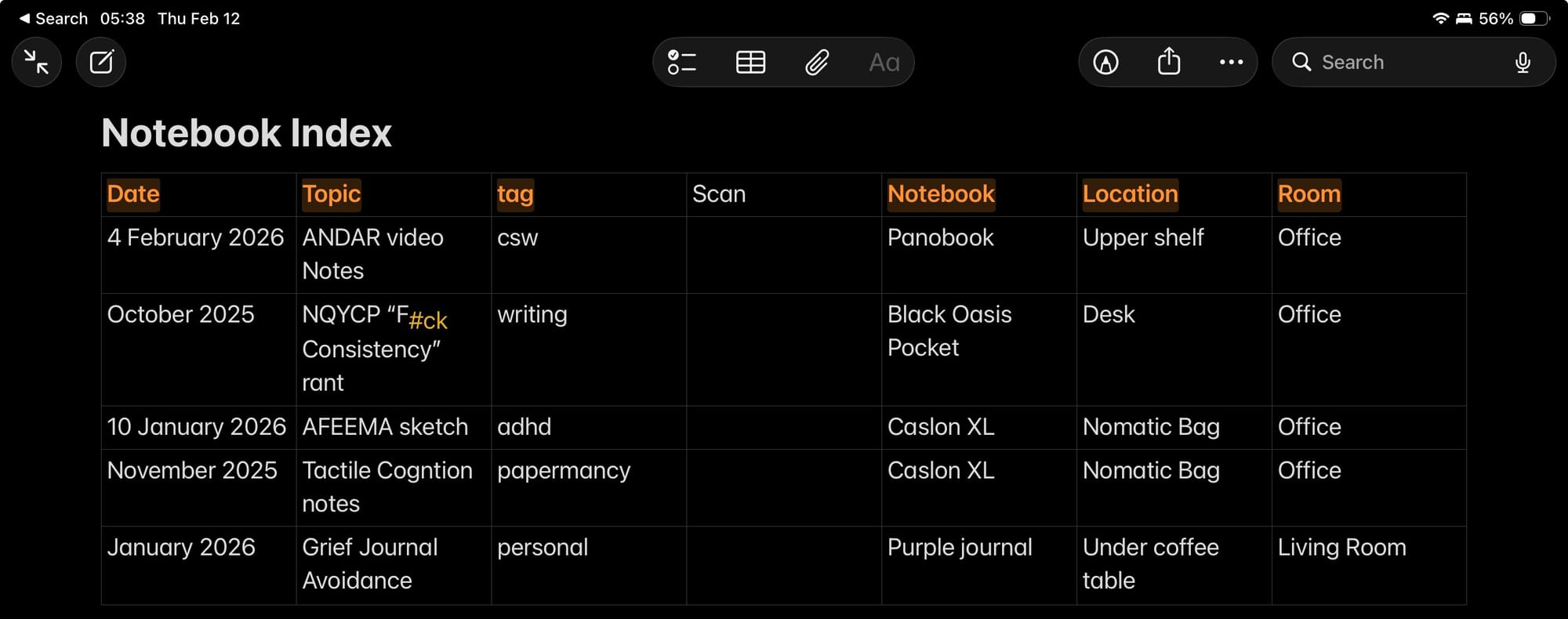
I’m using Apple Notes because it’s free, I’m a Mac guy, and it’s both universally accessible (even on my watch!) and remarkably durable (my earliest note still stored there is from 2012).
But it doesn’t matter. Use obsidian, notion, excel, airtable, whatever you like. You don’t even have to use a table if you don’t want to.
I would recommend, though, a minimum of the following information for each entry.
- Date: (as specific or as vague as you want; sometimes it’s down to the hour for me, sometimes it’s just a year)
- Subject: Not a clever title, not some coded system. This should be the answer you would give a friend if they saw you writing a note and said “hey, what’s that note about?”
- Notebook: This doesn’t have to be too complex either, but it should be specific. “Black Moleskine” wouldn’t narrow it down much for Devin, but “Black Moleskine with 2024 HIVE Fest sticker” might work.
Personally, I find that there are a few other things that I’d like to know:
- Tags: I know, the infosphere is torn about the uses or abuses of tags. I find that one, no more than two, is helpful when I search.
- Scan: Apple notes lets me put images into my notes, so if I’ve taken a snapshot of a page I’ll put it here (or a link to it).
- Location: not where the notebook should be; this is where it lives. And if you have multiple notebooks, you know that’s a true difference. For me, it’s not just the room but also where in the room I keep it — or, at least, last saw it.
The final step is to “pin” the note in the Apple Notes app, so that it is always the first note whenever or wherever I open it.
The Weak Point in the System
This spreadsheet is like any tool: it only works if you use it. And the biggest hurdle to this particular system is to both remember to make an entry when you’re putting away or reviewing your notes, and then (shout out to my ADHD peeps) actually making the entry.
Ideally, I like to do it note by note, always making it the last thing I do before closing the notebook. More realistically, going through all the notebooks I used during a week is more likely, more useful…and more difficult.
Weekly reviews are something that are inarguably useful and needed in my life. There was a time when I did it religiously with a small group of people…and for some reason, it doesn’t happen now.
But that’s a different problem for a different article. The point is, the note index needs to be both easily accessible and often accessed for it to be any use.
Want to try it out? I’ve got you started with this Open Document format spreadsheet identical to the one I use. It’s free, of course (I mean, come on, it’s literally one header row of a spreadsheet) so feel free!