Stop Optimizing Your Notebook. Start Flirting With It.

Why tactile rituals create better thinking than perfect systems
Ever been sorry when you reach the last page of a notebook?
Or dropped it in a puddle, picked it up and waited for the pages to dry and then decided “$#@& it, crispy pages are a delight” and kept on using it?
That’s because for some of us, the notebook we use stops being a container and start being a conversation partner. It’s a guide and a guard dog to explore the inside of your head — a guide because it lets you create a map of where you’ve been, what thoughts you’ve had along the way, and even the areas ahead that might be best labeled “Here Be Monsters”.

And a guard, because when you don’t feel like dealing with those monsters, you can close the cover and the notebook will keep them safely contained.
Just a quick note: if you like this kind of stuff, you should join us for our fortnightly Papermancy Guild Hearth every other Sunday at 11am CST. We hang out, share projects, talk about inkin’ and thinkin’ and basically have fun. Click on that link or use the QR code at the end of this article to come on in!
Like it or not, how much our brains use something depends on whether we like it or not.
I heard an ADHD coach who specialized in helping neurodivergent folks better handle time. I was excited, because like me, she absolutely recommended a paper planner.
But then she lost me. “Nothing fancy, nothing in it except where you need to be and when.” I imagined that kind of book. A utilitarian tome that had nothing in it except my marching orders, my obligations, all in identical text on identical pages. No difference between “Date Night” and “Mortgage due” and “Review Q3 Numbers with Finance”. No acknowledgment that while all appointments are measured with the same quantifiable elements — minutes, hours, days — they are vastly different in terms of quality.
No, thank you. I know that my ADHD brain doesn’t like purely abstract systems, because I find them boring. I respond to sensation, friction, flirtation.
Tactility is not decoration. It’s feedback, and it’s feedback that is literally more visceral than just an idea. It’s a shortcut that enables my nervous system to know “this matters” without having to convince your prefrontal cortex like it’s a hostile witness.
When I talk about taking the time to personalize and bespoken your notebook, I’m talking about creating a system of felt signals, not pretty pages.
If they look pretty too, that’s all well and good. But it’s not the point.
Give your notebook a body, not just a brain
Look, if you like Moleskine pocket notebooks, or want to just use the plain brown Field Notes editions all the time, I’m not going to say you’re wrong.
But they will. That’s why you can find entire stores filled with variations on Moleskine notebooks and other office supplies (I remember my friend Evan bought their ridiculously expensive pen, just so he could let me use it once and understand what I was missing. Evan is cruel.) It’s why Field Notes has a “colors” subscription, where you get a different set of notebooks every quarter, in a “seasonal design.”
They don’t want you to get too attached. If your notebook feels irreplaceable, they can’t sell you more. On the other hand, if it feels interchangeable, your brain treats it as disposable, easily substituted by a New Shiny Notebook.
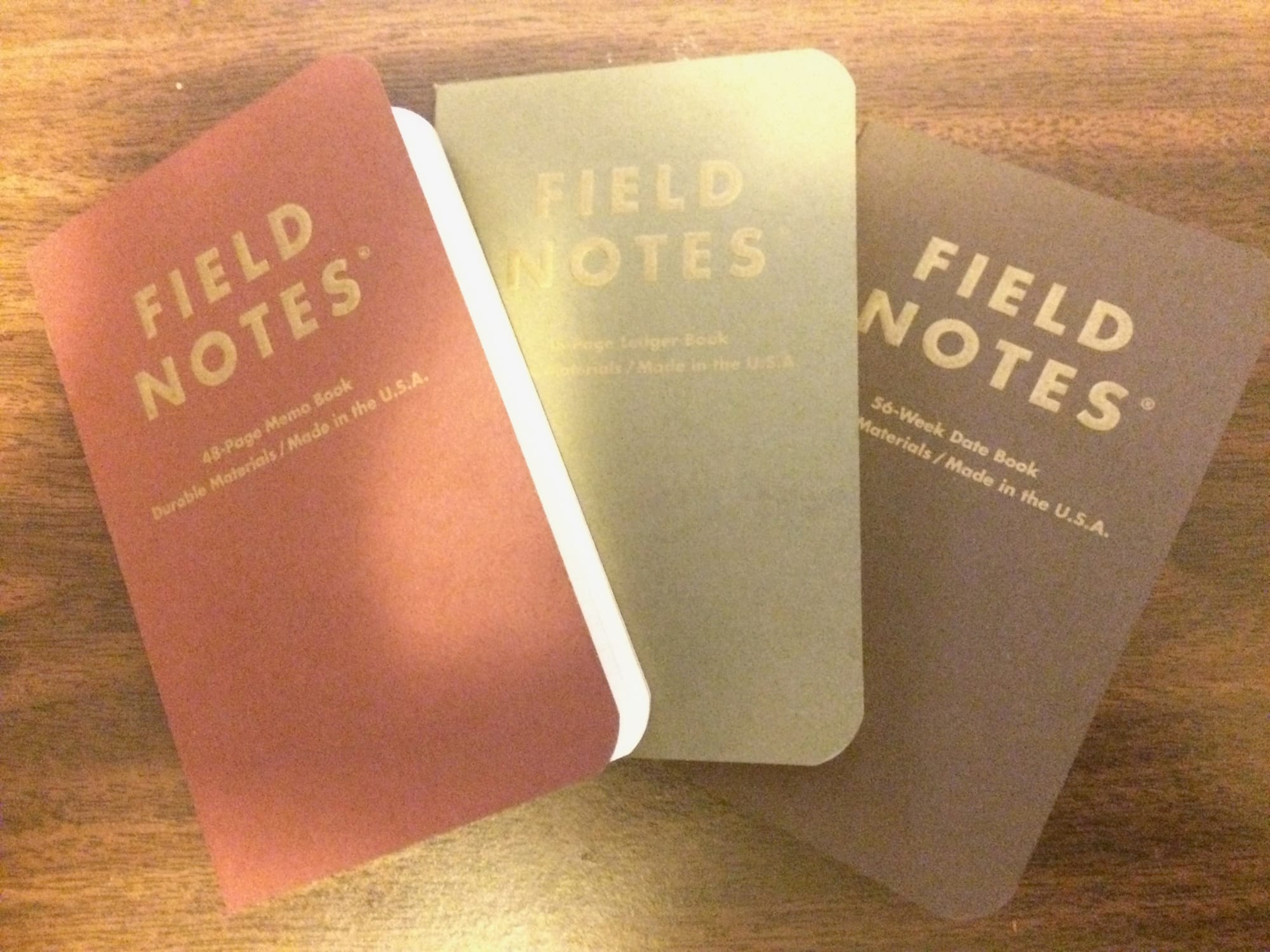
If you don’t want to be going through a lot of notebooks, you want weight, resistance, and a little personality.
Heavier paper, that slows your pen down because it just feels good. A thicker cover, just enough to create intention and value for the work done inside. The texture—fabric, leather, rough paper—creates a subconscious ritual: I am touching the door to the thinking place now.
For me, this is what changes my notebook from a place where thoughts go to die to a place where they are planted and given room to grow.
If you ever find yourself stroking the cover absentmindedly, it’s probably a good notebook for you.
Encode meaning through touch, not color theory
I can’t speak for everyone, but I love creating color systems for journals. In my digital planner I even went so far as to literally use the exact brand identity hex code for the color of my work appointments. The idea that if you have everything color-coded it will be more understandable is great… until it isn’t. Wait, which shade of blue is supposed to be grandkids time?
Tactile systems, on the other hand, don’t require memory. They require fingers.
And it’s not about using different pens for different categories — instead, think of using different pens for different modes of work.
Perhaps it’s a gel pen that glides effortlessly for drafting, mind mapping, brainstorming. A heavier fountain pen with fancy ink that drags a little for thinking slowly and intentionally. A scratchy, slightly obstinate ball point pen for angrily writing the “I don’t want to do this but I must” items in your date book.
Some people like to use “washi” - Japanese paper- tape, which can have distinct textures and patterns. It’s not only about brightening the page — the extra layer becomes a physical bookmark, denoting things like “important but not urgent” or “come back when braver.”
Or there’s the simple paper hack of folded page corners — which I’m aware infuriates some people. Part of the Papermancy project is the “bookcharm”, which starts as a regular bookmark but can become a task manager, a place for marginalia, or even a clip to connect or hold a place.
Whatever you use, the idea is that tabs you can feel without looking are wildly underrated. Your hand can know where things live before your eyes do.
Intentionally build in friction
Productivity culture would like you to think that the secret to optimizing everything is making it smoother, faster, less effort.
They lie. Friction isn’t failure—it’s guidance.
The reason they want the system to be smooth is so that it becomes invisible. Unthinking. Literally inattentive. Then, they harvest the profit — whether that’s your personal information, an automatic subscription renewal, or showing you the things they want you to buy.
That’s not what you want for your thinking place. You want gentle resistance in the place of ideas, where attention should pause and nurture or weed them.
This looks like:
- Writing titles by hand instead of stamping them (yes, I’m aware of the irony of me using markdown for my own headers)
- Physically flipping to a specific page of your notes for a new day or new idea rather than having everything in one endless scroll of paper. If empty spaces bother you, fill them up later with zentangles or urban sketching.
- In fact, you can leave intentional blank space around unfinished thoughts — if the void makes you feel slightly uncomfortable, let it be a productive, itch-you’ll-scratch-later kind of motivation.
Friction is not about punishment — in fact, it’s the opposite. Giving your ideas and your fingers something to rub against (if you’ll pardon the metaphor) makes it all the more likely you’ll reach for it instead of the black mirror.
Let pages show their mileage
Using tactile cognitive tools means you are creating an artifact of your life. As it ages, it shows the scars, repairs, misbehaviors, becoming a unique talisman because of the evidence of use.
Those infernal dog-eared corners become reminders of the experiences they point to. Fingerprints from writing so angry that the ink didn’t dry, or the raised strokes on the previous page from pressing your pen so hard into the page. Ink bleed-through, the ubiquitous coffee rings.
These are not flaws; they’re memory anchors.
When you flip through your notebook, feeling the thickness change, catching your thumb on a warped page, your brain says: “Oh. Yeah. I remember that.”
I remember. That’s absolute treasure for an ADHD mind like mine, that struggles with the half-century of memories it’s trying to contain.
I find that if I have a notebook that is pristine, it probably means I’m emotionally avoiding it. My “grief journal” about my daughter’s death is a good example, as is the reception book from her funeral. I don’t like going to that place — so I need to figure out what I can do to make it more comfortable for the rest of my body and soul.
Micro-rituals for my hands
When a lot of people hear the word “ritual” they think incense and chanting. If that works for someone, great, but it’s not about the materials, it’s about the experience. Specifically, a ritual needs two things:
- repetition
- sensation
With a notebook, this might look something like this:
- Setting the notebook, closed, in the spot where you’re going to be writing.
- Finding the pen or pencil and placing it, closed, next to the notebook.
- Getting the support materials — a cup of coffee, a water bottle, headphones (connected to a phone that is not on the table), ok, fine, you can have incense too if that helps.
But that’s only the preparation for the ritual. How are you going to open the notebook? Are you going to review the previous page? Or start on a blank one? Do you open your pen before or after the notebook? Tapping the pen twice before starting, running a finger down the margin before writing the first line…these are part of the ritual.
And closing it with intention, not just snapping it shut like a laptop. Taking a moment to rest your hand on it, giving it the space of a breath, acknowledging its role in holding the thoughts for you so your brain is allowed to let them go.
This is the quiet magic behind sustainable systems—the counter to the people who tell you “just open up the notebook and write!” Sometimes that works — for stuff that is easy. For harder thoughts, deeper work, you need a different kind of practice — one that invites you back instead of shaming you for leaving.
The problem with the mind/body split is that it pretends that your consciousness is independent of the rest of your nervous system. Going through this kind of preparation, these gestures, it tells your body: we are entering the thinking space now.
You don’t need willpower. You need to create the space where the only thing that makes sense is to make marks in the notebook — words, images, doodles, or angry scars that honor the pain you feel.
Different thinking, different rituals
In spite of those digital numbers incrementing with atomic precision, the experience of time is different depending on what you are doing. That one meeting might be going on forever, whereas your grandkid grew up overnight. It’s been ages since you’ve seen that one friend, but when you get together over coffee it feels like no time at all.
Not every kind of tactile cognition needs the same ritual, the same sensory channel.
If you’re going to brainstorm, you need something that is loose, fast, permissive. Lots of blank paper, reliable, flowing ink, colors and arrows and connecting lines.
Weekly planning needs to feel firmer, a solid framework to build your plans with the resilience not to fall apart when things gang agley, as they do aft.
Reflection, though, needs to be indulgent and slow as slipping into a bubble bath, taking the first sip of fine wine or first bite of tiramisu. It’s slow, letting the brain bring up the memories and their accompanying thoughts in a supported space.
It’s developing an epicurean, or even erotic, relationship with your notebook practice.
The erotic is a measure between the beginnings of our sense of self and the chaos of our strongest feelings. It is an internal sense of satisfaction to which, once we have experienced it, we know we can aspire.
— Audre Lorde Uses of the Erotic: The Erotic as Power
I’m not saying you have sex with your notebook practice (though Anaìs Nin might have some opinions on that), but rather that you make an effort to include sensation with your thought.
Once you start doing this, you can leverage your environment and sensations to support whatever kind of writing you want to do. Sitting cross-legged on the floor with a soft notebook is not the same cognitive mode as sitting upright with a hard-backed journal on a desk.
Use paper size, pen tip width, writing angle, or posture. Lighting, sound, solitude or partnership or the combination of both you get at a coffeeshop.
You’re not just writing—you’re setting the stage for the act of writing.
Yelp your practice.
There’s a lot of people who will object to these suggestions as a waste of time and resources. That’s fine, because I’m not trying to suggest a practice that is more “productive”.
I am suggesting a practice that you want to inhabit.
The question is not “Is this system efficient?” The question is, “Do I want to touch this?”
If the answer is no, I don’t care how many books and videos David Allen and Tiago Forte have published, your brain will ghost it. Lovingly. Repeatedly. Without apology.
All of us are changing, whether we want to or not, and our world is changing as well. Your writing practice — whether it’s journaling, blogging, memoir, fiction, or epic history — is a place where you can choose the changes, make them fit your needs and desires. Pay attention to what it feels like — could your chair be more comfortable? Does the pen feel right in your hand? When you touch the paper, is it meh or ooh…?
I’m not saying it needs to be perfect before you can write. I’m saying that making it a little better will be worth it. Iteration is sexy.
Your notebook should feel a little bit like your best friend who has the key to a hidden door to your secret garden, your magic laboratory, the invisible library.
You don’t need a better productivity method. You need a notebook you actually want to touch.
Don’t try to do all of this at once.Start small. Change one sensation so that it feels better. One ritual that puts space between your every day and your inner thoughts. One piece of friction that makes you slow down just enough to feel something before you think,
If you’re curious about building a notebook practice that treats paper like a thinking partner — including tactile rituals, pocket codices, bookcharms, and other forms of what I call Papermancy — you can explore more at papermancy.art.
Until then, treat your notebook kindly. Let it age badly — trust me, the mileage looks good on it. Let it get stained, warped, and crowded with evidence of the life you shared inside it.
Do you have a notebook story to tell? Join us every other Sunday — starting Feb. 8, 2026 — at 11am CST at the Papermancy Guild Hearth!