A Free Downloadable ADHD Self-Care Bingo Zine
Fold it up, put it in your pocket, and every once in a while during the day you can mark off things as you do them. Use a red pen, or get some little stickers, or maybe even an actual bingo stamp to mark things off as you do them. The prize for getting five-in-a-row? You’re that much healthier. WIN!
Complete with squirrels and an appendix on hybrid digital/analog layout
We’ll start with the easy stuff:
I’ve created a bingo card specifically to help people with ADHD increase their chances of doing things that often help with executive function and other challenges.
These are not necessarily complex things, but they are things that we ADHDers often forget or don’t think of. For example, I know, both epistemically and experientially, that I get more easily into writing flow when I’ve got music in my ears. And yet, when our Shut Up and Write leader here at the coffee shop told us to do just that, I put my earbuds in…and forgot to actually start the music.
Until I started writing about things on the bingo card…so now I both have Bust the windows out your car in my ears and a little red X over the accompanying square in my Monday card:
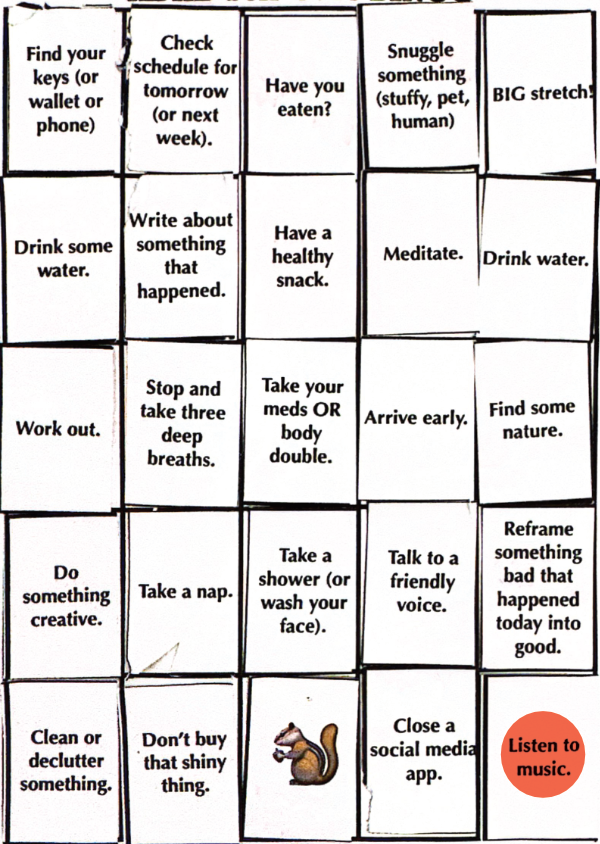
You will note, of course, that there is the traditional “free” square, represented by a squirrel — personally, I interpret this less as “free” as much as “I know I’m going to get randomly distracted by something today because that’s how my brain works, let’s celebrate that.”
(It’s also fun to stamp red dots on pretend squirrels).
A weekly self-care coach
You may also note that I said “Monday Card” — that’s because I envision this as a companion to the Codex method, where you fold (and maybe cut) a single piece of paper into a little book. If you download and print out this free pdf (well, it’s really pay what you want, but I’m telling you, you can just grab it) pdf you can print out your own.
Fold it up, put it in your pocket, and every once in a while during the day you can mark off things as you do them. Use a red pen, or get some little stickers, or maybe even an actual bingo stamp to mark things off as you do them.
The prize for getting five-in-a-row? You’re that much healthier. WIN!
Now, my intrepid gamified ADHDer, how many bingo streaks can you get in one day? (gasp) Can you…possibly…fill up the whole card?
Yeah, it totally plays on the whole competitive/completionist/novelty/tactile vulnerabilities of really any brain, but especially ADHD ones.
But it’s using the power for good.
It’s all yours.
If you do try it out, I would love it if you would tell me one thing: did you name your squirrel? I’m not sure why, but I can’t think of the squirrel’s name. Nor am I sure if one ADHD Self-Care Bingo Card has one squirrel returning each day, or seven different squirrels.
I’m not sure it matters, either, but still: enjoy!
Now for the nerdy philosophical stuff: why not just use AI?
The idea for this zine progressed as follows:
- I started with just the idea for a card.
- I populated most of it with things I knew, plus some suggestions from other ADHDers (thanks, Natasha & Karl)
- I laid it out in a spreadsheet program.
- I realized I wanted to shuffle the prompts, so not every day was the same.
- I realized how tedious that would be using the spreadsheet.
I think that most brains, about that point, would think of using AI to randomize the lists into seven different cards — and I did, indeed, think of that.
Unfortunately, my brain doesn’t stop there. What would really be cool would be if people could suggest their own self-care squares. And then have those randomized. I wonder if I could use AI to vibe-code that?
And what’s scary is: I could. I did, in fact. Python code (written by AI) put in my Very First GITHub repository and deployed to a lovely little community-web-app platform called Streamlit: ADHD Squirrel Bingo Generator.
You may have to click on the “wake up” button if it’s been a while since someone’s used it. But it works! You can use the default list I made, or you can put in your own, and then you end up with a simple zip download of however many .xlsx files you wanted. It’s not formatted or prettified, but it works.
To be honest, it’s kind of terrifying. It’s like learning the magic words to a spell that you don’t understand. But I was right — it was just a few seconds before I had the seven cards randomized as I needed.
And it was honestly kind of boring.
I realized that I’d traded joy for efficiency.
There was another way for me to do this: I could print out the first sheet, cut up the squares, and randomly put them back down in a grid. A quick scan with my phone of each hand-picked layout would give me the kind of grainy, wabi-sabi feeling that the zine world is rooted in.
So that’s what I did:
And then about an hour spent with the Affinity app (because I don’t like renting software) and I had the layout I needed.
For me, it was the perfect example of finding the joy in a project. I didn’t like the idea of having to reshuffle the elements of the excel sheet — but I liked the idea of finally joining my nerd heroes on GIThub and try out some of that “vibe coding” all the kids are talking about.
But while the experience of that was exhilarating, the product was…underwhelming for me. Doing it by hand — cutting the paper, feeling the individual pieces, seeing the unique layouts of each, even changing the ways I laid them out, all made it feel much more fun, and much more mine.
I’m not saying I did it the right way — I’m saying that I did it the way that was fun for me. And it will hopefully help me question, in the future, whether I am trading efficiency for fun.
One can hope.