Do You Know the Difference Between a Rock and a Stone?
“ The hard part to understand — and even harder to internalize — is to recognize that these talismans, regardless of their significance, are simply representations of the experience.”
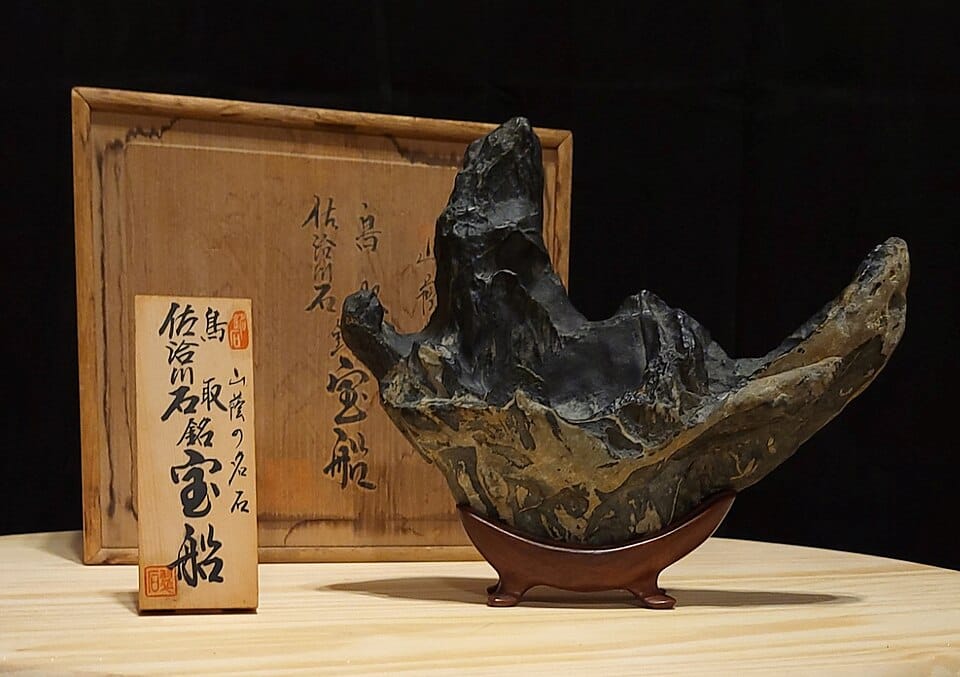
The Japanese art of suiseki answered the question that had been keeping me up at night.
A big part of many journaling practices is gathering and keeping the various printed artifacts of life: ticket stubs, programs, menus, business cards, stickers, receipts, name badges, just to give a few examples.
These are often referred to as “ephemera” which I think is a misnomer; the act of saving them is literally an attempt to de-ephemerate whatever they are (“Ephemera? I barely met ya!”). When I teach the four-piece “Papermancy” practice, we make a particular folder — the “fragmentarium” — specifically to keep these little proofs-of-life to be added to our journal — “grimoire” — later during a ritual of reflection and memory.
But there is a fine line between “collecting” and “hoarding.”
The fragmentarium works well enough for a weekly practice of collecting and processing the things that I encounter now, but what about the half-century of time before I started that habit?
I have cigar boxes full of nametags from various conferences I’ve presented at, attended, or even created. I have portfolios bursting with posters and programs from performances I’ve been involved in, and folders full of files from my schooling, military service, and college. I have albums of photos of family members I can’t name, ex-girlfriends that I (mostly) can, and odd places here and there that must have seemed significant at the time but now are long forgotten.
And I’m scared of getting rid of any of it.
For many of the usual reasons, to be sure — as a former follower of the Kondo method, I recognize that there are a lot of psychological factors that make us think we “should” keep something. I may feel that it is a symbol of an accomplishment, or a relationship, or a debt, and that by discarding it I am somehow ungrateful, or imposter, or dishonoring a memory.
Then last year, my youngest daughter unexpectedly passed away.
Suddenly every school drawing, every extra school photo, every deleted digital photo album seemed like a betrayal. Suddenly there was a mad scramble to find and digitize every piece of video with her in it. Because suddenly these things became precious simply by their scarcity; there would never be any more.
But the reality is that the map is not the territory.
The hard part to understand — and even harder to internalize — is to recognize that these talismans, regardless of their significance, are simply representations of the experience. Me not fitting into my Marine Corps uniform doesn’t make me any less a Marine; the fact that my Dad’s college diploma had his name scratched off doesn’t negate his journalism degree. The fact that the State of WI no longer recognizes domestic partnerships doesn’t change the commitment I have to my partner.
And no number of pictures and videos — big or small — will ever capture or limit how much I loved my daughter.
Which means we’re safe! One of the big lessons of papermancy and the fragmentarium is: you don’t have an obligation to the paper. We don’t have to keep it, maintain it, preserve it, use it, or give it away unless we want to. Call it “papermantic agency”: we use the paper to help us think, remember, create, but the choice to do it is our own; the paper doesn’t care either way!
That’s all well and good, but the heaps of papers remain in the basement, and the question becomes: if I know I want to keep some, but not all, how do I pick them out?
Memnants, suiseki, and stones, oh my!
As I mentioned earlier, I don’t like the term “ephemera” for the things we want to keep, because…well, because words have meaning, dammit, and I’m a prescriptivist in the sheets and a descriptivist in the streets. If I’m trying to preserve it, it’s not ephemeral!Plus, I always love a chance to coin a new word, and so when I talk about what to do with the things you put in your fragmentarium folder, I talk about turning them into “memnants” — remnants of an experience you want to remember.
I’ve got a whole outline of an article where I try to explain the differences between ephemera (which you dispose of) and memnants (which you keep) and how to turn one into the other…but I may end up throwing it away completely. At the very least I’ll be re-writing it, because of a conversation I had at a family gathering last Sunday.
I met the parents of my youngest daughter’s boyfriend, and they are delightful. Judy, his mother, practices and teaches ikebana (Japanese flower arranging) and his father, Roger, practices suiseki, which is, well, for lack of a better term, Japanese stone arranging. Or perhaps “appreciating” would be a better term.
When I asked what that looked like, he answered with a question: “Do you know the difference between a rock and a stone?”
I looked at him, warily, as only two grandpa-jokers can. “Before you asked, I thought I did, but now I believe perhaps I don’t…”
“If you’re walking along, and you see a rock, and you kick it aside, that’s just a rock.” His smile grew. “But if you’re walking along with someone special, and you see a rock, and you pick it up and share it with them — now it’s a stone.” Judy was smiling too, and he nodded. “A stone is a rock with a memory attached.”
Now I know how to sort through all that ephemera.
If I pick up a name tag from an event I attended and I can’t remember a damn thing I did there? Not worth keeping.
On the other hand, I have two nametags from one event because I lost one. The original (which of course I found in my luggage after the event) is spotless. The replacement that the patient staff had given me is hand-written, with a coffee stain on half of it and a hastily scribbled class schedule on the back.
Not difficult to understand which to keep, and which to discard.
It’s not about “sparking joy”. Not all memories are good. Sometimes it might be necessary to keep something because the pain or grief is still there, and it’s not ready to be let go.
Like “memnant”, “suiseki” is an amalgam of two words: sui, water, and seki, stone. It is so evocative of everything about time, memory, ripples, permanence…I’ve only begun learning more about the practice, and I don’t know that I’ll ever practice (certainly not with the skill Roger has) , but just the simple name and essential description of his practice help me attend to questions I’ve had about my own.
But wait. There’s more.
While researching for this article (and my own curiosity, of course) I learned something else about the practice of suiseki:
”A key principle of suiseki is that the stone should not be carved, polished, or otherwise reshaped to enhance its suggestive qualities; alteration is conventionally limited to what is needed for stable display, such as the fitting of a base.
Which means there’s not only lessons about memory and attention; there’s also a practice of accepting the form as being enough.
Worthy of attention and appreciation as it is. Without alteration, improvement, or critique.
Just like you and me, or course.
But sometimes it’s hard to remember that in the noise of the world.
It’s nice to have memnants and stones to remind us.
If you like the idea of grimoires and memnants and paper-based tactile cognition, you might enjoy attending one of our bi-weekly “hearth” gatherings full of inkin’ and thinkin’! Sign up for the newsletter to be notified of the next one.